Two outlets report that ChatGPT now declines to write text in the exact style of named authors, offering original prose in its own voice instead. Ars Technica documented refusals across living and deceased authors; Android Authority, which alone makes this connection, ties the change to OpenAI's copyright lawsuits — though that causal link is unconfirmed by any other outlet and by OpenAI itself. Android Authority, again the only outlet to say so, characterizes the change as one OpenAI made 'quietly,' a detail no other source in the cluster corroborates. Neither outlet establishes when OpenAI made the change or why, and by the accounts of both outlets — the only sources here — OpenAI has issued no confirmation or rationale, a point that remains unconfirmed elsewhere.
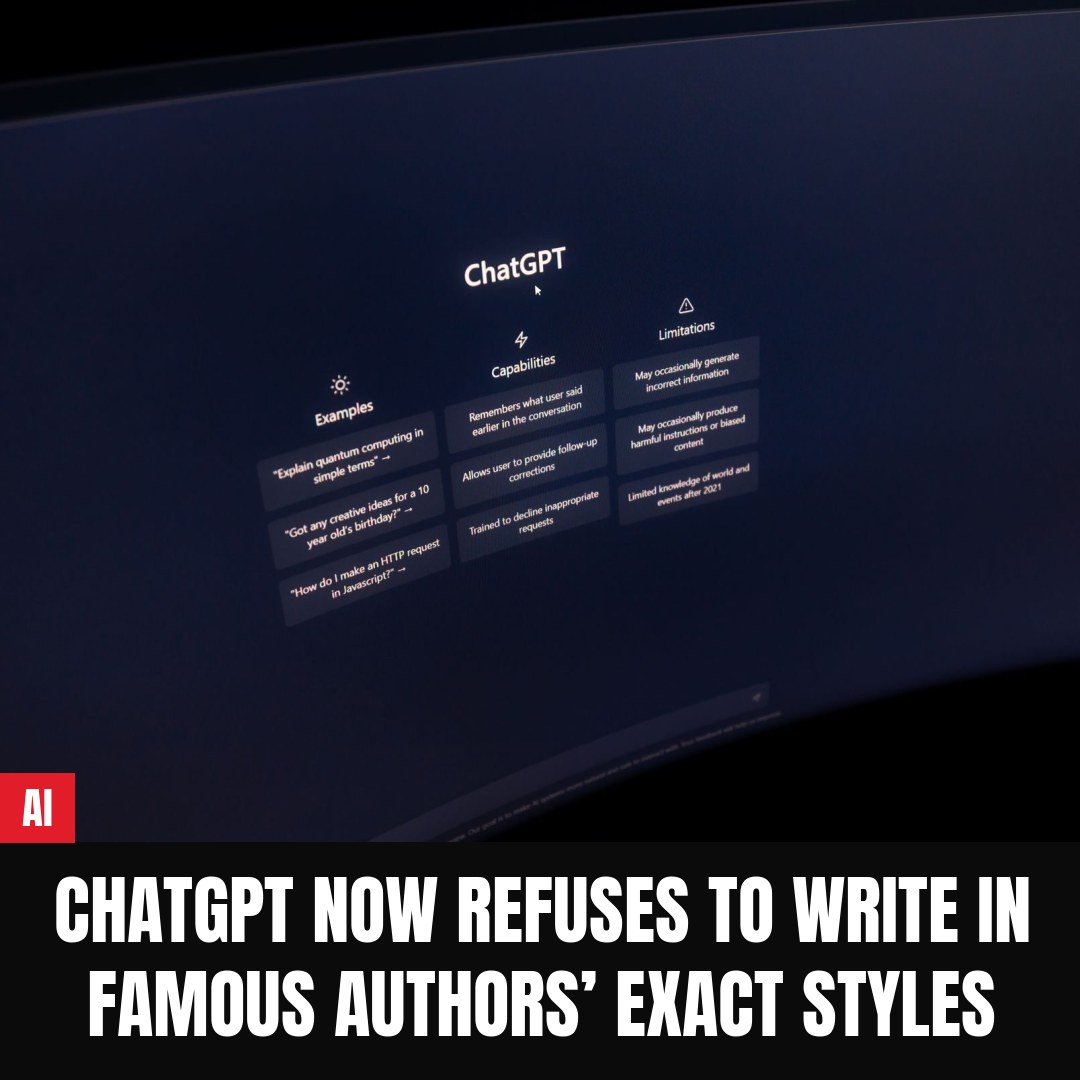
ChatGPT now turns down requests to write in the exact style of famous authors, according to Ars Technica and Android Authority, the two outlets covering the change. Ask it for a story opening in the manner of Stephen King and it will offer something atmospheric and original instead — while telling you plainly it won’t imitate King’s voice. Ars Technica, the only outlet to quote the refusal directly, reports the chatbot saying as much, though no other coverage corroborates the exact wording.
Both outlets agree on that much. Beyond it, the coverage is thin, and the most important questions go unanswered by either: when OpenAI made the change, and why.
What Happened
According to Ars Technica, which alone reports this test, the outlet ran a prompt asking ChatGPT for a story introduction in the style of Stephen King and received a refusal to imitate his exact style, paired with an original horror opening. No other outlet has corroborated this account. Ars quotes ChatGPT’s reply directly: “I can definitely write with the hallmarks of atmospheric, character-driven horror and small-town dread, but I can’t write in Stephen King’s exact style or closely imitate his distinctive voice. Here’s an original opening that captures a similar feeling while remaining its own…”
Ars Technica, which alone reports this level of testing, says ChatGPT gave similar refusals for the living authors J.K. Rowling and Amy Tan and for the deceased authors Charles Dickens and Ernest Hemingway — a list of names, including both Amy Tan among the living authors and Charles Dickens among the deceased authors used in testing, that comes solely from Ars Technica and has not been confirmed by any other outlet. That detail matters, because Ars also cites an analysis published earlier this month by a group it names as No Latency, which it says found ChatGPT refused style-copying for living authors but complied for deceased ones — an analysis relayed only by Ars Technica and not independently verified. If Ars’s own testing is right, the behavior has since tightened to cover the dead as well as the living — but that comparison rests entirely on one outlet’s account of both the earlier analysis and its own results.
Android Authority describes the same underlying shift and characterizes it as a change OpenAI made “quietly.” The outlet also links the move to OpenAI’s ongoing defense against multiple copyright lawsuits. Neither the parties nor the status of those suits appear in the reported facts.
Who This Affects
The people named in the coverage are authors whose styles were used as test cases: Stephen King in the prompt Ars Technica ran, plus Rowling, Tan, Dickens and Hemingway in Ars’s wider testing. None of them are reported to have commented, and neither outlet includes any reaction from authors, publishers or legal experts. For ChatGPT users, the practical effect is narrow but concrete — a request phrased as “write in the exact style of [author]” now draws a refusal and a substitute, at least in the cases Ars tested.
What Has Changed
The before-and-after here comes almost entirely from Ars Technica’s citation of the No Latency analysis. Earlier this month, according to that analysis as relayed by Ars, ChatGPT would refuse to copy the style of living authors but would comply for deceased ones. In Ars’s own later testing, it refused for both. Read together, that suggests the restriction widened. But the whole arc depends on a single outlet’s telling of two separate pieces of evidence, and the exact date of any change is not established in the facts.
Timeline
- July 27, 2026 — Ars Technica received a response from ChatGPT declining to write in Stephen King's exact style; article published (Ars Technica)
- July 28, 2026 — Android Authority article published, tying the change to OpenAI copyright lawsuits (Android Authority)
Key Features
- ChatGPT declines requests to write in the exact style of a named author.
- It offers original text drawing on the author's broader qualities while staying in its own voice.
- In Ars Technica's testing, refusals covered both living authors (Rowling, Tan) and deceased ones (Dickens, Hemingway).
Expert Analysis
The strongest evidence in this story is also its weakest link. Ars Technica supplies the only quote, the only test prompt, the only named authors and the only reference to a prior analysis by No Latency. That is a lot of load-bearing detail carried by one outlet. Android Authority corroborates the broad behavior — that ChatGPT now declines style-copying and substitutes original prose — but adds no independent testing of its own in the reported facts.
The two outlets do not contradict each other. Where they diverge is in framing: Android Authority reaches for a cause, tying the change to OpenAI’s copyright lawsuits and calling it a quiet move, while Ars sticks to documenting the behavior. Neither claim about motive is confirmed by OpenAI in the facts I have. “Quietly” is an inference, not a statement from the company, and the copyright-lawsuit link is presented without the parties, the dates or the status of any case.
There is a cleaner test the coverage never runs. If the change were genuinely about copyright, you might expect it to fall hardest on authors whose work is still under copyright — the living, and the recently dead. Ars’s finding that refusals now extend to Charles Dickens, long in the public domain, cuts against a purely legal explanation. That tension sits in the facts unexamined, because neither outlet has OpenAI’s rationale.
What This Means
For now, what’s solid is small: two outlets independently describe ChatGPT refusing to mimic named authors’ exact styles and offering original text instead. What’s shakier is nearly everything a reader would want to know next. We don’t know when OpenAI made the change, whether it issued any statement, whether it applies to every author and every prompt, or whether free and paid tiers behave the same way. Android Authority’s copyright framing is plausible but unconfirmed in these facts.
Until OpenAI says something on the record, the honest summary is that a behavior changed and two outlets noticed. The reasons are guesswork.
Pros and Cons
Pros
- ChatGPT now provides an explicit refusal and a stated boundary rather than silently imitating a named author.
- Users still receive usable original text that draws on the requested genre or mood.
Cons
- Requests to write in a specific author's exact style no longer work as before.
- OpenAI has offered no reported explanation, so users cannot tell how consistently the restriction applies.
Frequently Asked Questions
Will ChatGPT still write in the style of a specific author?
According to Ars Technica and Android Authority, no — ChatGPT now declines to copy a named author’s exact style and instead offers original text in its own voice that draws on the author’s broader qualities.
Does this apply to authors who have died?
In Ars Technica’s testing, refusals covered deceased authors including Charles Dickens and Ernest Hemingway as well as living ones. Ars also cites an earlier No Latency analysis that found ChatGPT once complied for deceased authors, which would suggest the restriction has widened. Both points come from Ars alone.
Why did OpenAI make this change?
Neither outlet reports an official rationale. Android Authority links the change to OpenAI’s ongoing copyright lawsuits, but that framing is not confirmed by OpenAI in the available facts.
When did the change take effect?
Neither outlet establishes a date. Ars Technica’s test response is dated 27 July 2026 and its article the same day; Android Authority published on 28 July 2026.
Conclusion
The single fact worth watching is the one nobody has yet supplied: an on-the-record word from OpenAI. Whether the restriction is legal caution, a policy choice or a quieter model change, the company has not explained it in anything the two outlets report. Until it does — or until more testing maps exactly which authors and prompts trigger a refusal — this remains a documented behavior in search of a reason.
Photo by Matheus Bertelli on Pexels