
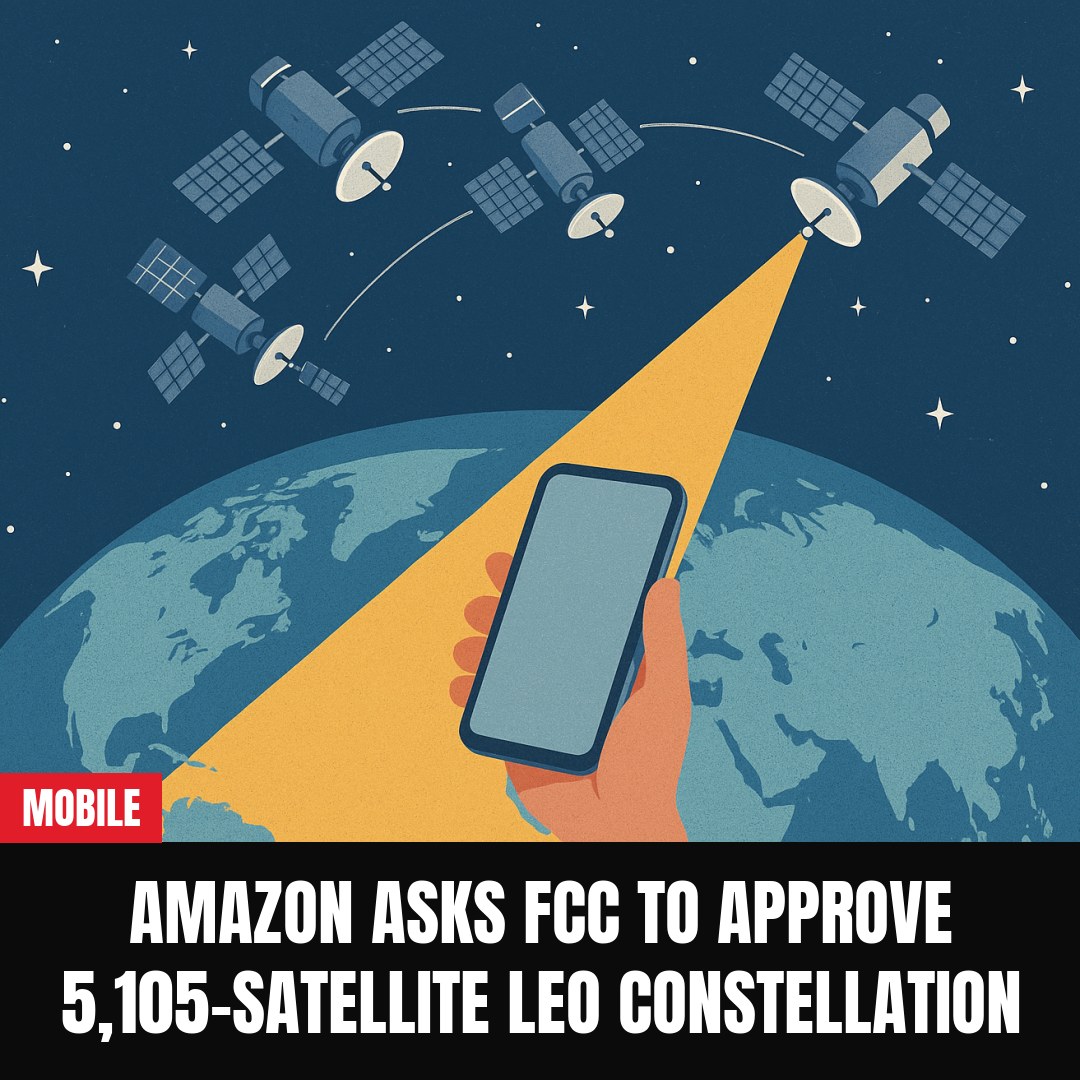
Amazon has filed an application with the FCC to launch and operate a constellation of 5,105 satellites for a direct-to-device service called Amazon Leo, positioned against Starlink and built partly on the Globalstar network it is acquiring. The Verge and Android Authority agree on the filing and the satellite count but give different accounts of when service or deployment begins, one saying 2028 and the other pointing to later this year.
Amazon has asked the Federal Communications Commission to approve a constellation of 5,105 satellites to power a direct-to-device service called Amazon Leo, according to both The Verge and Android Authority. That headline figure is where the two outlets covering the filing agree cleanly. Almost everything about the timing does not line up.
The filing is the concrete part of the story. Beyond it, the coverage splits on when Amazon actually intends to put satellites in orbit and when customers might see a service, and neither outlet resolves the gap.
What Happened
Both The Verge and Android Authority report that Amazon filed an FCC application to launch and operate 5,105 satellites, and that these will power a direct-to-device satellite service. Both describe the project as Amazon Leo and frame it as a competitor to Starlink. Both also report that Amazon is acquiring Globalstar’s satellite network as part of the effort.
According to The Verge, which alone reports the timing, the filing was submitted on Saturday — though no other outlet confirms this date; Android Authority, for instance, does not date the filing. Neither outlet states an exact calendar date, but computing that Saturday against The Verge’s 2026-07-27 publication would place the filing on 2026-07-25 — an inference not stated by either outlet and unconfirmed elsewhere. The Verge adds — in a claim no other outlet corroborates — that the service would provide voice, messaging, data and emergency services, and that Amazon plans to work with mobile network operators in the way Starlink has partnered with T-Mobile — a partnership the identification of T-Mobile as Starlink’s operator being reported by The Verge alone and not confirmed by any other outlet. Android Authority, for its part, is the only outlet to report that the direct-to-device service will work on compatible smartphones with built-in satellite-capable chipsets — a detail that remains unconfirmed elsewhere — and, again per Android Authority alone and unconfirmed by any other outlet, that the system will run alongside Amazon’s existing satellite networks and Globalstar’s constellation.
Background
The two outlets both tie the plan to Globalstar, whose network Amazon is acquiring, but they date that acquisition differently, and neither account is corroborated by the other. The Verge says Amazon announced it earlier this year, while Android Authority — the only outlet to give a specific month — says April. According to The Verge, which alone reports this and whose account no other outlet corroborates, Amazon is taking over Globalstar’s existing deal to provide direct-to-device satellite services for Apple devices — a claim that, if accurate, would put Amazon into a supply arrangement with a major handset maker.
Who This Affects
The direct-to-device framing points at ordinary smartphone users. Android Authority is the only outlet to spell out the mechanism, saying the service would work on compatible phones carrying satellite-capable chipsets. The Verge describes a broader set of functions — voice, messaging, data and emergency services — and a plan to route the service through mobile network operators rather than sell it directly. Both descriptions rest on a single outlet, so what a subscriber would actually get, and through whom, is not something both sources confirm.
Timeline
- July 25, 2026 — Amazon files FCC application for the 5,105-satellite Leo constellation (per The Verge, which dates the filing to Saturday) (The Verge)
- January 1, 2028 — Amazon will begin deploying the constellation if approved, according to The Verge (The Verge)
Key Features
- A constellation of 5,105 satellites, the one number both outlets agree on
- A direct-to-device service branded Amazon Leo, positioned against Starlink
- Built partly on Globalstar's network, which Amazon is acquiring
- Voice, messaging, data and emergency services, per The Verge alone
Expert Analysis
The core of this story is solid and the edges are soft. Both outlets independently report the FCC filing, the 5,105-satellite count, the Amazon Leo name, the Globalstar acquisition and the Starlink comparison. When two outlets land on the same specific number, that number is worth trusting.
The timing is the problem. The Verge, which alone reports this detail, says Amazon will begin deploying the constellation in 2028 if approved — a date no other outlet corroborates. Android Authority says Amazon plans to offer an initial service later this year. Those two statements are hard to square: a company that has not started deploying its main constellation until 2028 cannot obviously be running a consumer service in 2026 — unless the early service leans on Globalstar’s existing constellation and Amazon’s current satellites, which Android Authority separately says the system would operate alongside. Neither outlet does that reconciliation for the reader, so it stays an open question rather than a settled fact.
The acquisition date is a smaller discrepancy of the same kind. The Verge says “earlier this year”; Android Authority says April. April is earlier this year, so these are not strictly contradictory — one is just vaguer than the other. But it is a reminder that the two accounts were not built from the same underlying detail.
What This Means
What Amazon has done is file. Approval from the FCC is a separate step, and neither outlet gives a timeline or the criteria the agency would apply. Neither reports the financial terms or size of the Globalstar acquisition. Neither carries any response from Starlink, T-Mobile or Apple — the companies most directly implicated by a rival constellation and a possible Apple supply deal. Android Authority — the only outlet to make this characterisation — describes Amazon’s push to compete with Starlink as progressing slowly, a framing that no other source corroborates and that sits awkwardly against The Verge’s account of an imminent-sounding filing.
For now the reader has a confirmed application, a confirmed satellite count and a confirmed acquisition target — and two different stories about the calendar.
Pros and Cons
Pros
- The satellite count, the FCC filing and the Globalstar acquisition are each reported by both outlets, giving the spine of the story two-source support
- A direct-to-device service could reach standard smartphones with the right chipset, according to Android Authority
Cons
- The two outlets give incompatible timelines — 2028 deployment versus a service later this year — and neither explains the gap
- The FCC has only received an application; approval timing and criteria are not reported
Frequently Asked Questions
How many satellites does Amazon want to launch?
5,105, according to both The Verge and Android Authority. It is the one figure the two outlets state identically.
When will Amazon Leo be available?
The two outlets disagree. The Verge says Amazon will begin deploying the constellation in 2028 if approved. Android Authority says Amazon plans to offer an initial service later this year. Neither reconciles the two.
What is the Globalstar connection?
Amazon is acquiring Globalstar’s satellite network, both outlets report. The Verge says the acquisition was announced earlier this year; Android Authority says April. The Verge alone says Amazon is taking over Globalstar’s deal to provide direct-to-device services for Apple devices.
Has the FCC approved it?
No. Amazon has filed an application. Neither outlet reports a decision timeline or the criteria the FCC would use.
Conclusion
The next thing to watch is the FCC itself. Everything reported so far hangs on an application, and neither outlet says how long a decision on a constellation this size might take or what would decide it. Two figures also need reconciling before the launch picture is clear: a 2028 deployment start and a service arriving later this year cannot both describe the same rollout without an explanation nobody has yet given.
Illustration generated by AI